Enterprise RAG
Ask in plain language and get cited answers from manuals, contracts, policies and emails, without depending on someone remembering which folder the document is in.
What is enterprise RAG?
RAG (retrieval-augmented generation) is the technique that lets a language model answer using the actual content of your documents, instead of whatever it learned during training.
Replaces the search that finds nothing
Your intranet or document manager's search looks for exact text matches. RAG understands the question and retrieves the relevant passage even if it doesn't use the same words.
Works on what you already have
Manuals, contracts, minutes, policies, spreadsheets. They get indexed exactly as they are today, with no folder reorganization and no system migration.
Every answer cites its source
A specific document and page, not a generic answer with no way to verify it.
The real cost of not finding information
Time spent searching, not working
Every employee who stops working to dig through a manual or ask a colleague is time you don't get back. Multiplied across the whole team, it's one of the largest hidden costs in a mid-sized company.
Knowledge that leaves with people
When the only way to know something is to ask whoever has been around the longest, that knowledge disappears the day they leave. RAG keeps it searchable for anyone, indefinitely.
Decisions made without full information
If finding the right document is too costly, decisions often get made without it. A system that answers in seconds changes that dynamic.
From question to cited answer
Multi-format ingestion
PDF, Word, Excel, PowerPoint, emails. Each document type is processed with its own parser, including tables and images.
Semantic indexing
Content is chunked and converted into vectors that capture meaning, not just exact words.
Hybrid retrieval
For every question, it combines semantic and keyword search to find the most relevant passages.
Generated, cited answer
The model writes the answer from those passages, always pointing to the document and page each fact came from.
Where the payoff shows up
Internal support / IT
Answers repetitive procedure questions without a technician having to step in every time.
Legal and contracts
Finds specific clauses across hundreds of contracts in seconds, with the exact page.
HR
Employees check vacation policy, benefits or procedures without opening a ticket.
Operations and quality
Checks procedure manuals and technical standards without depending on who happens to know them by heart.
Enterprise RAG vs internal search
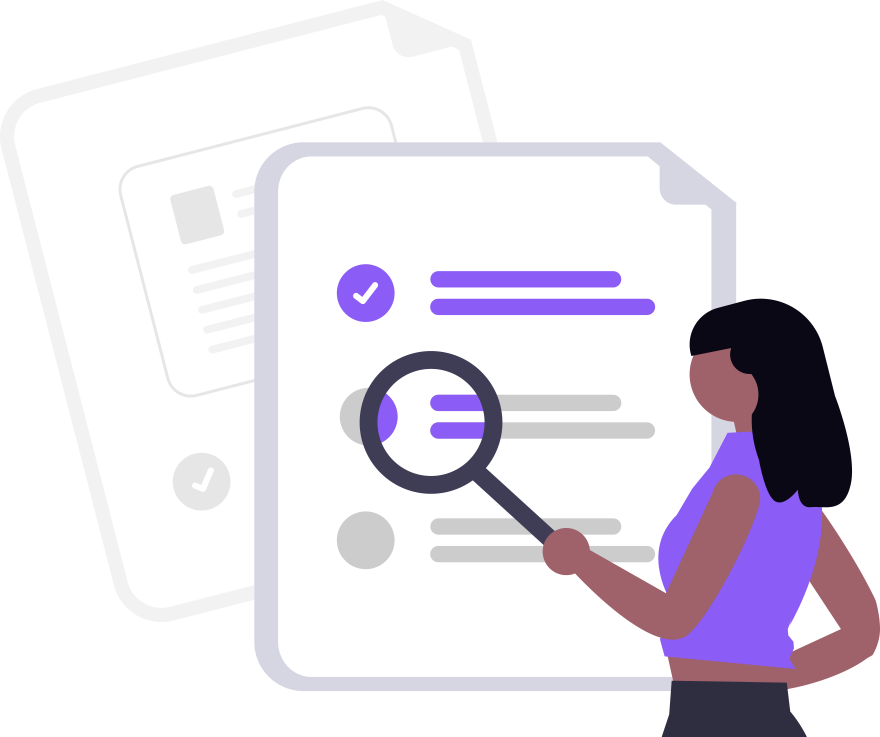
Classic intranet or document-manager search indexes words. RAG understands questions.
Before you ask
Which document formats does it support?
PDF, Word, Excel, PowerPoint and several more, including tables and scanned content via OCR when needed.
Do we need to reorganize our folders before starting?
No. It connects to the folder structure, intranet or document manager you already use, as it is today.
How long does it take to index our documents?
Depends on volume, but a corpus of several thousand documents is usually ready in hours, not days.
Can it get things wrong or make up an answer?
The system is designed to answer only with what it finds in your documents; if it can't find a good enough source, it says so instead of making one up.
Is this the same as Zaviren's private AI?
RAG is the technique that makes answering from your documents possible; private AI means all of that runs inside your own infrastructure, without going to a third party's cloud. They go together: more detail here.
Let's see it with your data
A 30-minute call to figure out which case makes sense to start with in your company.